
3 Ways to Learn Spanish in Ecuador (What Worked for Us)
 Reading Time: 23 minutes
 For many travelers, the main reason for being in Cuenca is to learn Spanish. Noted by many as one of the better areas to learn Spanish – in part because of the locals slower pace of speaking (especially when compared to other Latin American countries) Cuenca is a hub for foreigners studying Spanish.

How to Learn Spanish in Ecuador
In this post, we’ll discuss three ways to learn Spanish in Ecuador: classes, books, and immersion.
1. Learning Spanish in Language Classes
The city of Cuenca has dozens of great schools, including:
We studied at Simon Bolivar Spanish School, and found that one teacher to 2 students was a great format for learning. The classes moved along at our pace, with the teacher able to spend more time on things we needed and skipped over other parts we knew, which is something that’s impossible in a larger class format.
Costs were surprisingly low – just $180 for the week for two adult, at 4 hrs per afternoon (our daughter sat in on the classes for no charge). This works out to just $4.50 per hour, per person.
This is fairly typical, although the costs will be significantly higher if your teacher travels to your home. Located just off Parque Calderon, you can skip out to one of the many cafes/bakeries on one of the afternoon breaks, or simply take a quick stroll through the Parque.
2. Learning Spanish with Books
We brought a few books with us – but not enough – it’s nearly impossible to get English books here in Ecuador. Well, truth be told, there are a few bookstores – here in Cuenca, and a few both in Guayaquil and Quito, but the selection certainly isn’t what I’m used to.
Also we were using Rosetta Stone before moving to Ecuador, and continue to use the course. Although much of the vocabulary didn’t stick (like we hoped) it really helped us to get a “feel” for the language – its flow and general sounds.
This really helped us on our arrival and in the Spanish classes. That being said, it might have helped us more, if we weren’t so busy with preparing to move abroad – selling everything we owned including our home, business, and all of our stuff, with the exception of 6 bags of checked luggage and our carry-on electronics.
Given more time, I think we could have come with much more Spanish – the Rosetta Stone format is very good. It works on the premise of complete immersion. There is no English in the course – you learn everything in Spanish. And although it sounds overwhelming and quite possibly impossible – it really isn’t.
The one point of note – be sure to order Latin American Spanish – otherwise you’ll arrive talking like you’re from the “old country” (Spain) and although you might be understood, you’ll also raise a few eyebrows.
Here is the complete list of books and courses we used to learn Spanish.
After we arrived, an Ecuadorian friend recommended Madrigals Magic Key to Spanish and loaned us a copy. Since then, everyone (every gringo at least) tells us how much that book has helped them.
So its been ordered from Amazon.com and is coming with Canadian friends in February. There really is nothing like a personal copy that can be truly studied.
The other thing that you should consider is Pimsleurs Spanish. If you just want to give it a test, get a 7-day trial for free. After that, there is a monthly subscription fee. But even if you subscribe for a whole year, it will cost less than a week class we took in Cuenca, Ecuador. But you probably won’t need it even half of that time.
3. Spanish Immersion is the Best Teacher
Along with all these different ways of learning, immersion has been our best teacher. We have been involved in a significant amount of volunteer work and this has improved our Spanish more than anything else.
After just over 4 months, we are really surprised with our level of comprehension and ability to communicate. Still a long way to go, but we aren’t nearly as mute as when we first arrived.
While there are numerous indigenous languages spoken in Ecuador (including Quichua – in the Sierra, and Shuar – in the Amazon), the only language you really need to be concerned about is Spanish.

What Language in Cuenca Ecuador?
Spanish is the primary language in Cuenca – as it is with the rest of Ecuador.
Here in Cuenca, you’ll find that virtually every taxi driver speaks some, if not fluent, English, because of living in New York.
Also, English is taught in schools and colleges, so many locals have a very basic understanding of some English words. That being said, it is worthwhile having a basic understanding of Spanish.
There are numerous free courses online, and some computer-based courses that can give a basic understanding.
Also, once here, there are a number of very good Spanish schools. You can have a private tutor for just $4-5 per hour, or you can join a group class for a little less.

How We Learnt Spanish in Ecuador: A Work in Progress
It has often been said that total immersion in a foreign language is the best way to learn, and while this is definitely true, lessons certainly help.
But with such a huge learning curve, the biggest question is, where to start?
How We Are Learning Spanish
We have tried all kinds of different lessons, Rosetta Stone, audio lessons, podcasts, books, and real-live teacher-student face-to-face lessons, but by far the best thing we’ve found is an audio course by Pimsleur.
When we moved here friends told us to wait at least a year before taking lessons from a teacher, but we were anxious so we signed up about five months after we arrived.
Well turns out our friends were right. The teacher was excellent, she even spoke English really well, but it was too much too fast. Our heads were spinning, and we really didn’t retain much.
The Problem with Rosetta Stone Spanish
The problem with Rosetta Stone, and the other courses was that they only teach words or phrases consisting of a few words each. We were trying to learn but were unable to speak in intelligent polite sentences, we have found that this ability is essential to communication (sarcastic smile inserted here).
With Rosetta Stone in particular, one of their selling points is about total immersion, which works well in real life. But Rosetta Stone uses pictures, and does not use any English to explain them.
The absence of English is not help, it’s a hindrance, for example when the program was trying to teach me the word for “I have” I thought they were teaching “I touch,” the absence of English makes the course confusing, and they only teach present tense.
Why Pimsleurs Helped Us Learn Spanish
It was only after we started the Pimsleur course that we began to get a handle on the normal flow of polite conversation. I found it very frustrating that the other courses were teaching me to say things that I would never use at this stage in the learning process.
Things like: “Do you drive to the library every day?” Am I really going to walk up to a stranger and say that?
With Pimsleur (check out our review) I started off learning how to say “Pardon me Sir, good afternoon, I speak English, do you speak English? I speak a little Spanish, and I only understand a little, thank you, good bye.”
This I could begin to work with. Each lesson builds on the one before and they are only 30 minutes each, you are recommended to only do one a day. We have found that this really is the best way to learn because it sinks in, and it’s not overwhelming.
The school we took our classes at is called Simon Bolivar, it’s right here in Cuenca and I would recommend them, after about a year of immersion, and Pimsleur.
9 Reasons I Love Total Language Immersion

When we moved here a year and a half ago, we didn’t know any Spanish, we’ve enjoyed experiencing immersion for the first time, but there have been some difficulties along the way.
One of the best ways we find to deal with these kinds of difficulties is to tap into our sense of humor.
I’ve been told that it takes around four years to become really fluent in everyday conversation; we still have a long way to go. My husband and daughter have found immersion a little easier than I have, my husband is naturally more vocal than I am, and my daughter has a young fully absorbent mind.
Because of this, my sense of humor has had a better workout than theirs, so here are a few of the reasons I’ve “loved” the journey so far.
1. …it brings me in tune with my basic instincts
All my response mechanisms become heightened. I follow every hand and facial gesture of each speaker, trying desperately to read the mood of my subject.
I instinctively pick up on the fine nuances of happy, or possible angry/annoyed vocal manifestations, so I can quickly contort my facial muscles into what is hopefully the correct response to whatever it is that they’ve been saying.
I sit in an intent, uptight position with every muscle flexed, taking on the characteristics of what might remind some of certain small nervous woodland creatures, squirrels or chipmunks perhaps.
This total mind/body workout is exhausting, and I know I’ve followed the program correctly when I stumble through my front door after a full day of immersion with that telltale headache, and bittersweet craving for my pillow.
2. …I love surprises (like at a restaurant)
I try to decipher the options on the menu, time and again, and then order what I think is a beef dish.
Upon the initial taste test, I quickly realize that it’s not beef, it’s pork, or is it chicken? Surprise!
3. …being humiliated brings out the best in me
I stand in front of the clerk at the grocery store with a blank expression on my face because she just said something to me, and is now waiting for my response.
My ten-year-old daughter senses my hesitation and instantaneously responds to the clerk, then turns to me and graces me with a translation of the aforementioned undecipherable attempt at communication.
She makes sure to mix in a “this is so easy mom, don’t you get it?” tone, just to make sure the humiliation level has been sufficiently tweaked to her satisfaction.
I smile and nod as the clerk so thoughtfully points in my daughter’s direction, giggling about the fact that my young daughter is more fluent than I am, and henceforth directs all questions/instructions to her.
As we return home and walk through the front door, I pass her the receipt and ask her to go balance the budget, she looks at me with a stunned look on her face “what?” she says. Too bad that clerk’s not there to see my little victory.
4. …it brings my relationship with my husband to a totally new level
It has enabled me to absorb the sympathetic energy running from my husband’s heart through to his hands. He no longer has to utter a word.
After a full day of immersion-oriented errands, and various other social activities, he simply puts his hands on my shoulders, leans forward gently pressing his forehead to mine.
Then as I see that sympathetic half-smile, half frown appears on his face, my tears begin to flow and I know we have achieved that zen-like state that can only be found during the early months of total immersion.
5. …of the “smile”
After about a year and a half into it, I find myself staring at newbies with that unavoidable “smile” plastered on my face, remembering how I felt when I was standing in those brand new squeaky shoes.
The smile comes as I relive past awkwardness, and relax into the reality that those days are over (well almost 🙂 ).
6. …of the “shock”
The shock also comes after about a year and a half. I’ll be going over a recent conversation in my mind, remembering the details and directions with ease, and then the “shock” hits me as I realize that the conversation took place totally in Spanish!
I experience a little sense of exhilaration, and I’m ready to ask where the bathroom is again, the next time I’m at that cafe.
7. …the more the new language takes over, the worse my spelling and grammar become in my native tongue
8. …it’s one of those buddy experiences
I think it’s called “total immersion” because when you are totally immersed, let’s say in water, you might panic a bit and feel like you’re drowning.
But after a while you realize (perhaps subconsciously, because you’re drowning) that if you can just reach that guy next to you, grab on tight and relax, letting them do all the work, soon enough you’ll get the general idea and be O.K.
So remember “never go total immersion-ing on your own, always immersion with a buddy.” Everything’s better with a buddy.
9. …it’s like an extreme sport for people that don’t like extreme sports
Your mind, lips, tongue, and teeth are always set to peak performance, while you are constantly aware that at any minute you could crash and burn right in the middle of a sentence. (Also the risk of death is much, much lower.)
If you’re thinking about trying total immersion, or if you’re in the midst of it, on the bad days (you will have them) take heart and know that we’ve been there too. And take a minute to jot down a funny take on your frustration, so you can share it with us on this post.
As you develop friendships, you will likely want to express your feelings. Here’s how to say “I love you” in Spanish.
How a Canadian Kid Learned Spanish in Ecuador (Process and Tools)
The following is a post by our daughter, written back in December 2013, when she was 13 years old.
We have been here in Ecuador for over 4 years. And now I know Spanish pretty well.
- But what is it like to learn a new language?
- What do you have to overcome?
- And how can you do this?
In this post, I will answer these and some other important questions.
What is it like to learn a new language?
Honestly, it is kind of hard.
But when you are a child… like most of you are, it isn’t as hard as when you are an adult. To be completely fluent in a language, you have to know that language from the age of 5 or younger. I am above that mark, I was 8 years old when I started to learn Spanish. But, at that age and up, you still have a pretty good chance :).
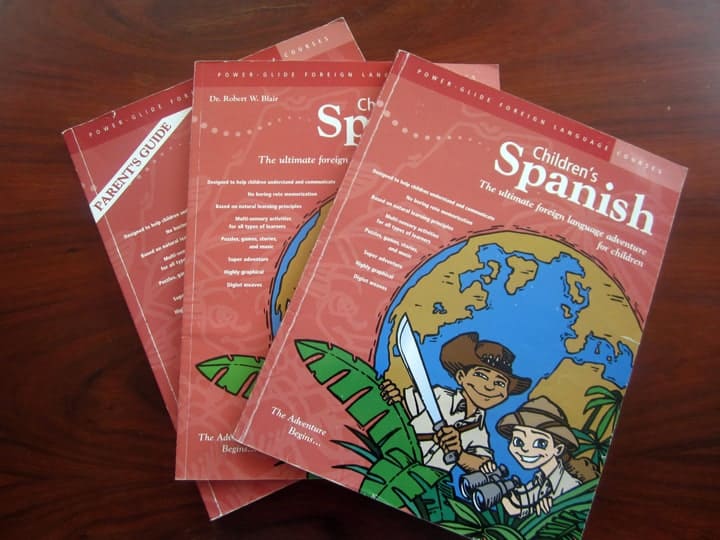
Before we moved to Ecuador, I took a children’s course for learning Spanish. It really helped me because it was fun and easy. It wasn’t just boring repetition.
It was built like a mystery with kids from the USA that had to go to Mexico to find a buried treasure.
As they searched for the treasure they had to learn more and more Spanish. It was a fun adventure!! It is called Powerglide Spanish.
I also found Standard Deviants helpful because they are funny and not based on memorization. There is a Basics and Beyond and a Advanced Verb dvd.
What did I have to overcome?
Mostly my own fear. I had a really hard time speaking at first.
For about 3 long months I didn’t say anything in Spanish! But all at once, I started talking. It felt pretty good! But what got me through those 3 months?? My puppy of course!!!!!!!! We got her only a month after we arrived and she became my super puppy!!!

How did I do it?
Here is a small list of how to make things easier, it worked for me!
- Take easy Spanish lessons
- Start talking
- Don’t be afraid of making mistakes
- Ask for help
- Be kind to everyone. Even if they don’t understand you, they will appreciate that you are nice to them because they know how you feel about them.
If you do this it makes things a lot easier! Trust me!! 😉
My experience
When we got here and everyone was speaking Spanish, I felt a little overwhelmed. All I heard was gibberish. I couldn’t understand a word. But little by little, I began to understand, and speak, Spanish. Now, people here tell me that I speak like I’m from Cuenca!! (in Cuenca people have a distinctive accent, they kind of sing their words).
Now I feel comfortable speaking the language! So if you are learning a new language, don’t give up! I’m sure that you will be able to learn it!! 😀 (but don’t worry… I still make mistakes :))
Google Translate is Awesome!
There is one more thing you should know. If you are traveling you will probably use Google Translate. While this can be helpful, it is not always accurate.
Here is an example: Have you ever heard the Fresh Prince of Bel-Air theme song? Probably. Here is the best parody of the song… put through Google Translate!!!!!!!!! cdza Fresh Prince Google Translated. Enjoy!!!!!!!!!!!!!
So I hope that you will take on the challenge and try to learn a new language. Life in another country is so much richer when you know the language!! Until next time and happy travels!!
3 Reasons to Learn Spanish Before Moving

We recently stopped by the post office in Cuenca to take care of some business and were amused to see a foreign woman loudly inquiring in English about the status of a package.
Apparently, the woman felt that if she just spoke English loud enough that she would be understood. She made no attempt whatsoever to speak Spanish.
The patient postal worker was doing his best to communicate with this woman, but he was clearly uncomfortable trying to answer her questions using his limited English.
The loud English-speaking lady was finally able to ascertain the status of her package and left the post office with a slight smile on her face.
She gave me the impression that she was satisfied with herself because she was able to accomplish a task without having to put forth the effort to speak Spanish.
This and other similar “language standoffs” between English and Spanish speakers raises the question: Is it really necessary to learn Spanish before moving to Ecuador? Can one get by with just speaking English?
Although some expats may argue that is not necessary to invest time in learning a foreign language before moving abroad, there are some valid reasons for learning the local language.
Should I Learn Spanish Before Moving to Ecuador?
1. Emergency Situations
Imagine that you wake up in the middle of the night and find yourself in need of emergency medical care. If you do not speak the language of the emergency personnel who answer your call for help, how will you communicate to them your exact location or explain the nature of your emergency?
We recently found ourselves in just such an emergency situation and were thankful that we were able to communicate in Spanish with the emergency room personnel.
If you are faced with an unexpected emergency situation, do you want to just assume that the operator who answers your call for help speaks and understands English?
Common sense dictates that you would need to learn at least some Spanish in order to get help in the case of an emergency. You might even say that it could be a matter of life and death.
2. Self Esteem
Recently we received a distress call from a friend who has been in Ecuador for a few months. She was stressed out because she was unable to successfully communicate with her landlord regarding an issue with her apartment.
Our friend speaks almost no Spanish and her landlord speaks no English. She made several attempts to communicate with the landlord and explain a rather complicated situation regarding the installation of her internet.
Our friend finally gave up trying to communicate with her landlord and called us for interpretation help. Our friend was frustrated because she felt helpless due to her inability to communicate in Spanish. She lamented the fact that she does not yet speak enough Spanish to defend herself in certain situations.
Had our friend started studying Spanish in the months or years before her move to Ecuador, she would no doubt feel more confident and satisfied with herself.
Curious about where to move? Here are 7 reasons that Ecuador is the best country for expats.
3. Quality of Life
Learning to communicate in the local language can improve your quality of life. How so? If you do not speak the language, you will be limited to a few nods and basic greetings when you meet neighbors passing on the sidewalk.
We have found that as a general rule Ecuadorians are interesting, sincere people who make great friends. The majority of our friends are Ecuadorians and we would not have been able to develop such good friendships had we not taken the time to learn Spanish before moving to Ecuador.
Also, learning Spanish has helped us to get a better understanding of Ecuadorian culture which in turn has enabled us to avoid being overly critical when faced with the inevitable “culture clash” situations.
Learning Spanish has also helped us to avoid feeling like outsiders in our neighborhood. A while back we got acquainted with an expat couple who had very limited Spanish skills.
Although they had lived in other Spanish speaking countries for a number of years, they just never got around to learning the language.
As a result, they had a generally negative view of Latin-Americans and felt unsafe in the neighborhood they lived in. They never got to know their neighbors and were suspicious of everyone.
It is possible that had they taken the time to study Spanish and learn something of Latin-American culture, they would have perhaps been happier living here. Instead, they decided to move on to supposedly greener pastures.
For our family, the years we have invested in learning Spanish have served us well. Being Spanish speakers has enabled us to form some good friendships, has helped us handle emergency situations, and has made us feel more self-reliant and comfortable living in a foreign country.
Fast and Easy Spanish For Busy Expats

Many people that move abroad are retired and don’t need to work.
This works out well when it comes to language learning because they have more time on their hands than people that need to work and take care of their children.
We are hearing from more and more families planning to move abroad. It can be a little more difficult to learn the language when you have lots of responsibilities.
Don’t fool yourself (like we did) thinking that you will have sooo much more time to learn the language once you relocate.
It’s true that you will need to work less because the cost of living is lower, but you will probably want to fill that extra time by doing things with your family. After all that’s probably part of the reason you are moving.
So start now, whether you’ve moved or not.
Language learning is a family activity, but the path of least resistance is pretty attractive, especially when you are adjusting to life in a new country. Your family will want time to give their brains a rest, so look for ways to learn that don’t seem so much like work.
We have had a bit of a struggle finding sufficient time to learn Spanish. It seems something always comes up which throws off our schedule. There is always something to do: clean the house, help Drew with her schooling, shop, cook, work, volunteer, family time…
How We Learn Despite Being Busy
We pick up a lot on the fly because most of our friends are Ecuadorian and only speak Spanish, so we are always learning through conversation. Our friends correct our mistakes and help us to understand what new words mean.
(Do you feel too shy to talk in Spanish because you don’t feel you can speak the language very well? Speak From Day 1 may help you get over that feeling.
I also try to set aside a little time every day to study verb conjugation. This part of the language has seemed overwhelming to me and I’m constantly making mistakes, but I’m beginning to see improvement.
I have recently started studying one type of verb at a time, for example regular “er” verbs. I write the verb out in the past – Preterito, present – Presente de indicativo and the future – futuro tenses. I also add the Perfecto de indicativo which is another past tense, because it’s easy and used a lot.
There are so many different verb tenses that trying to study and remember them all at once is too much for me. Choosing 4 tenses to work on has made it a little easier and once I master (here’s hoping) them I’ll work on some more.
This seems to be helping me grasp the conjugation better because I can see the pattern in what I’m learning. I pay special attention to the Yo (me/I) and Nosotros (us/our) conjugation because that makes up a large part of what I need to say when making conversation.
The book 501 Spanish Verbs is what I’m using, it’s a really good book. I do wish there were more examples showing how to use the conjugated verbs in sentences, but I guess I would not be able to lug the book around if that was the case.
Here are some of the other books and courses we used to learn Spanish.
Mobile Tools For Easy Spanish
- Pimsleurs has really helped because I can listen to it on my phone while I’m doing house work. And I really like the way Pimsleurs teaches Spanish. It is presented in conversation style and the repetition is good. As the program goes along they bring up past words and phrases making them easier to retain. Get a 7-day Pimsleur trial for free.
- SpanishDict.com is an excellent free resource. They send out a free newsletter, so every day I learn a new Spanish word. They give the word, the definition and some examples of how it would be used in conversation. I usually write the word and examples down in a note book. This helps me remember them better and work on writing the language at the same time. The videos are exceptional – and free as well.
Learning Through Osmosis… Kind Of
It also helps to watch movies, listen to the radio and read in Spanish. It will help a lot if you can incorporate Spanish into the things you regularly do. Even if you just pick up a word here and there each time, you will be capturing the sounds of the words and the flow of the language. Kind of like absorbing the language through osmosis 🙂
If you can watch a sitcom or movie in English and then again in Spanish, it’s even better. The same goes for reading, if you can download books in both languages and flip back and forth (from English to Spanish) as you read through the paragraphs, you will grasp the language much faster.
Which Language Was That In?
Drew and I went to a movie a couple of weeks ago and when it was over we both said that during it we kind of forgot which language it was in. It was in Spanish but we didn’t notice because we understood it so well. That felt good! The same thing happens to us when we remember conversations that flowed especially well.
How about you? How do you find ways to learn the language?
6 Tips for Learning Spanish Before Moving to Ecuador
If you are thinking about moving abroad to Ecuador (like I did) or to another Spanish-speaking country, you might as well as jump into the cultural richness.
However, I highly recommend doing some sessions with an awesome local tutor before you arrive to make that landing even smoother both linguistically and culturally.
“With just English, my life would be 20% of the richness that I have had.” – Tim Ferriss, Best-Selling Author
Learned By Me is an online language tutoring company that connects top Ecuadorian Spanish teachers with students for $15 one-on-one Spanish lessons over Skype. I am the country director for Learned By Me in Ecuador.
Our tutors often put together custom culturally rich curriculums to help new expats have a smoother arrival – both with the language and the culture.
6 Tips For Learning Spanish Quickly

Here are my 6 tips about how to get the most out of your tutoring sessions!
- Learn the basic phrases: Whether you are a Spanish pro or not, being able to say hello, how are you, I’ll take a canelazo, thanks (that’s a local drink here), etc. will go far in making your new country feel more like home.
- Learn about where you want to spend time: Arriving in a new country is an amazing opportunity, but it is also overwhelming trying to start a life with so many service providers and new friends pulling you in different directions. Use your Spanish lessons as an un-intrusive way to learn what you want about your new home from a local friend. Our tutors have repeatedly given me great tips about galleries, restaurants, and hikes I never would have known about otherwise.
- Develop the vocabulary you want to use: Just because you studied Spanish in school in academic setting doesn’t mean you are practiced speaking about the topics you really enjoy, especially culturally. I am a big food lover and cook, so it would have been a blessing to spend a few sessions with a tutor learning about the local dishes, styles of cooking, as well as things to avoid. (Otherwise, you’ll learn but it will be the hard way!)
- Get your first set of dumb questions out of the way: Part of the fun about being an expat in a new place is the slack you get for being clueless. (I remember repeated failed business lunches with my American coworker who didn’t understand that lunch at restaurants in Quito doesn’t start at noon.) However, being clueless can also be exhausting. Ask your tutor everything you are anxious or curious about – our tutors truly see themselves as local ambassadors and enjoy this process.
- Learn the local narrative: Newspapers are great but they often are more focused on news events than understanding the issues and content that are really engaging the people of the country. Your tutor is an incredible resource for getting you ready to speak about everything
- Make a lot of mistakes: Speaking a language that you didn’t grow up using is always challenging. The sooner you get comfortable and have fun making mistakes, trying new culturally appropriate words, and being outgoing about all of it – the more fun you’ll have when you get here.
Your Turn
How are you learning Spanish? What tools or courses are you using? What has been most effective for you? Let us know in the comments.







Great article! Even though Cuenca is a good place to learn Spanish, there are other options available as well, such as Guayaquil, the place I’m at right now. I teach Spanish here so believe me it’s also a great place to learn a new language and the sight seeing here is awesome. If anyone is interested, contact me: harrymoreno853@gmail.com
Thanks for the information
I am quite surprised to read that they speak slowly in Cuenca, since all the people from Ecuador that I met here in Italy (and there are quite a few) speak so fast I have a hard time understanding them, and I am from Uruguay! Well, maybe they are not from Cuenca…
Hi Bryan, thanks for the great info. My wife and I are thinking of living in Cuenca with our 6 year old just for the summer, say 4-8 weeks. My wife and I both speak intermediate Spanish. Do you think we might be able to find a summer camp or other fun activity for our daughter that would be immersion so we could all immerse ourselves in the language while we are there?
Good question. I don’t really know what activities are available for young children. I heard that there is a Facebook group for families with young kids, but I don’t know much about it. Our daughter is a teenager now…
This is a great blog. Have enjoyed reading it very much. What is the best area in Cuenca to live for two single older women.
Bryan-
What is the cost for the Spanish lessons? I don’t see that posted and would love to know.
Thank you
Kym
Hi Kym, I am Spanish teacher and I give private lessons. If you are interested you can write me to me e mail sand.juli@yahoo.com
Dear Brian..
Thanks for the great information about CUenca and Ecuador,, Im a CUENCANA!! owner of a Tourist Operator and Spanish School Cazhumaspanishschool,,, we are locate only 1 block from Calderon Park in a beutifull Colonial House, our programs are mixed! with Travel Tours to differents areas of Cuenca, while you are learning! spanish,, please i like to invite you !! to visit us..
Great to meet you Gabriela. We’ll drop in one of these days.
Thanks!
Bryan
Learn Spanish in Ecuador is very easy. The fact of being in a Spanish-speaking country will allow you to live a true immersion experience, because only few people speak English – therefore, you only hear people speaking Spanish!
In addition Spanish pronunciation, primarily in the Ecuadorian highlands (la Sierra), is very clear and quite slow. This helps in the learning process.
Also there is wide range of fun and interesting activities (some of them free and some at low cost) that you can enjoy while you know the culture and learn the language.
Another great advantage of learning Spanish in Ecuador is that there are very good schools that will help you to learn Spanish in very short time. We invite you to know our Spanish School: Andes Lingua
You are always welcome to our community!
Hi Bryan & Dena,
We request include our Spanish School in the current list. We invite you to visit us!
Greetings!
Thanks Carol!
Your welcome, thanks to you!
Hi I am Gloria. I`m spanish teacher for 20 years. I can teach in private classes( it`s includes my book). my email is: llactaecuador@gmail.com.
Saludos Bryan, realmente es grato saber que ayudas a otras personas para que puedan conocer un poco más sobre Ecuador, en este caso de Cuenca..
Gracias Juan!
Hi I am Spanish Teacher for 10 years, and tourist guide as well I can teach in privater classes, Write me If you want learn good English morenapink81@yahoo.com
Just to let you know your blog appears a little bit different on my galaxy tab.
Thank you so much for the wealth of information you provide on you site. My wife and I have our house for sale and are headed down as soon as it sells. I have a sister who has lived in the cotacatchi area for nearly 3 years and loves it. Although we havent visited, we decided all or nothing, and are making plans to be there before it snows here. We expect the culture shock, but hope to locate near other english speaking families. My retirement just isnt cuttimg it in the US any more, and my wife who works fulltime would like to retire with me and ecuador seemed like a good choice given the mild weather and cost of living. Hope to see you soon. The Cyr family, usa
Hi:
I have about 500 English books I want to sell, as I am moving back to Canada.
I miss my family too much.
I live in Manta If interested or someone else you know please let me know. Thanks Carol
Hi Carol,
What type of books do you have? I’ll certainly pass it on. You know, there is a bookstore in Cuenca that sells used English books. Its called Carolina Bookstore. Might be worth a call – maybe they’ll buy the whole lot.
Bryan
With the inability to find english books in Cuenca, have you considered buying a Kindle from amazon.com? We were always concerned with the strain on your eyes, but my wife just bought one with the new E Ink Pearl technology. It doesn't put any more strain on your eyes than a newspaper would. They have the Kindle now equipped with global 3g (which the map shows Cuenca would give you EDGE, which is 2g) so that you can dowload any book anywhere you may be, even in Cuenca. The best part is that you don't have to pay a monthly subscription fee, or any fee at all, for the wireless service. Or, you could always use the good ol' wifi.
Just thought you might like to know.
P.S. Thanks for the blog. My wife and I are looking at moving to Cuenca and your blog has been an IMMENSE help in our research!
Hi Rance,We have used Kindle from Amazon. They have a PC app so we can just read it on screen – not a nice as a read book (or even a kindle) but gets the job done. When friends visit, they come loaded with our orders from Amazon – print copies. Thanks for the feedback – really appreciate it!Bryan
What a great blog. Thanks for the time and information.
Thanks Ken – appreciate the feedback.