
11 Spanish Learning Books and Courses We Used (Print and Audio)
 Reading Time: 8 minutes
 Despite Ecuador being a Spanish country, we are asked if it’s necessary to learn Spanish before moving. The short answer is: “No, you don’t have to learn before you move.” We didn’t and we got by fine. But if you do learn Spanish (even in a basic form) before you move, life will be much easier.

11 Best Books to Learn Spanish: Our Picks
You’ll certainly want to learn it once you arrive in Ecuador or any other Spanish-speaking country.
It not only shows respect for your new host country, but it also makes your life easier and much more interesting. To get started, you’ll want to learn how to say the letters and sounds in Spanish.
Over the past 3 years, we’ve spent over $1000 on Spanish books, cd’s, software and classroom courses to learn Spanish.
See our reader’s choice: The Best Book to Learn Spanish
Really! Over $1000?! Just what did we spend all the money on? Aside from a Spanish course, we took here in Cuenca, everything we purchased were materials that we could use at home.
The Books and Audio We Used to Learn Spanish
Looking for great books to learn Spanish? Here are the ones we used:
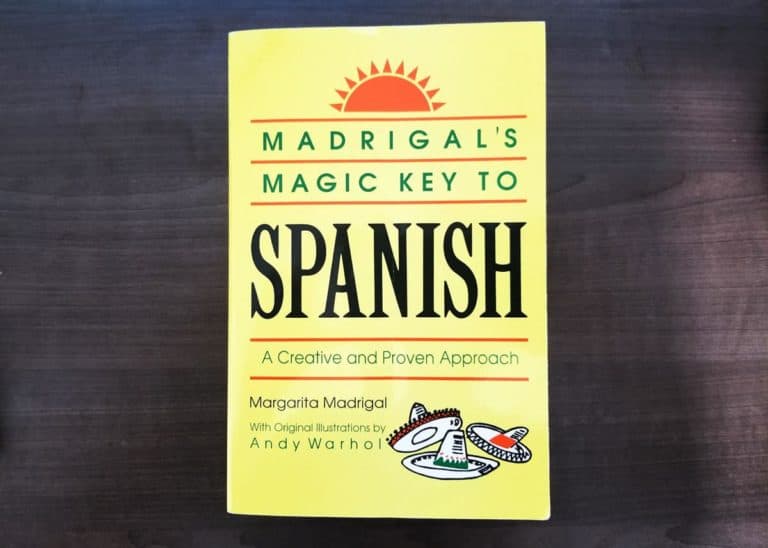
1. Madrigal’s Magic Key to Spanish
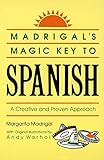
 This book was referred to us by one of the first Ecuadorian friends we made, the first week we arrived in Ecuador.
He actually had a copy in his house and he lent it to us (out of pity, I think). We didn’t even know how or when to say buenas tardes when we arrived.
In the first few chapters, the book covers hundreds of Spanish words that you already know.
Highly recommended. Read our full review.
Bottom line: Worth every penny
2. Pimsleur Language Programs: Basic Spanish

This course came recommended to us, but because of the cost – and its lack of flashy marketing (sorry, I’m a sucker) – we waited to buy it.
After struggling for a year here in Ecuador we purchased it online with Audible and it helped us the most of all the courses. Now you can buy directly from Pimsleur – from 1 week to a monthly subscription.
Its slogan is: Learn to Speak and Understand Latin American Spanish.
Price: Get a 7-day free trial. After that, there is a monthly subscription fee. Free lesson to monthly subscriptions – from $15-$20/month. (price depends on the package and currency)
Bottom line: If you are serious about learning Spanish, and don’t want to buy 11 different books and courses, buy this one.
3. Standard Deviants: Habla Espanol?

 This package includes 2 programs:
- Learning Spanish: The Basics
- Beyond the Basics
The actors can be a little over the top, but we found it actually helps us to remember the lessons better. Sometimes they are funny … other times just really corny.
Bottom line: It’s a great way to learn the rules. The result of the corny skits is that we remembered the lessons really well.
4. The Standard Deviants – Learn Advanced Spanish – Verbs


 Verbs are the problem area for all gringos – right after pronunciation. A slightly different emphasis on a word can change the meaning from first-person present-tense to third-person past-tense. Believe me, that can really confuse a conversation!
Check current price on Amazon
Bottom line: I’m a fan of the Standard Deviants series. We have 5 of their programs – certainly worth the money.
5. The Standard Deviants Super Spanish (4 pak)


 My favorite video Spanish course comes in a 4 dvd pack. A total of 330 minutes on 4 discs.
We have all of these and they are worth it, especially if you prefer visual learning to books.
Check current price on Amazon
Bottom line: These are some well-produced training videos that make it easy to assimilate the Spanish lessons. Highly recommended.
6. 501 Spanish Verbs with CD-ROM and Audio CD
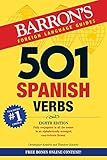
 In terms of a reference book, we couldn’t find a better one. The introductory 40 pages or so goes into detail explaining the different verb tenses and how they work.
While this isn’t recreational reading, it is an important key to properly understanding the language. And as a reference tool, it will serve you for years to come
Bottom line: A great reference book with a detailed section on verb tenses.
7. Spanish Verb Tenses Workbook

 Similar to the 501 Spanish Verbs (above) the Spanish Verb Workbook is a great way to get the hang of the verbs. While I haven’t gotten around to using this on, Dena uses it and likes it.
Bottom line: It won’t get any more boring than this, but worth the time to learn the verb properly.
8. Easy Spanish Phrase Book: Over 770 Basic Phrases for Everyday Use
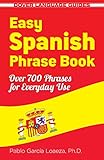
 This handy little book is worth having just to stick in your briefcase or backpack. It covers most of the basic things you’ll need to say – and you mix and match the rest.
What I love about the book is its phonetic spelling of Spanish words. It really helps to get the sounds under control and lose the harshness of the Gringo Accent.
Check current price on Amazon
Bottom line: At just two bucks, it’s hard to go wrong. It would be worth having one for every member of the family. We bought just one, and our new puppy went to town on it. You will learn from this little book.
9. Rosetta Stone Spanish (Latin America)
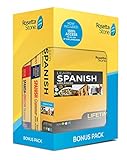
 The first big purchase we made to help us learn Spanish was the full set of Rosetta Stone. It was pretty expensive and it is a good tool.
It makes you reason on sets of images – with no English used at all. While that sounds intimidating, it actually works pretty well.
There are some drawbacks. For example, when a color is shown you’ll learn the Spanish word for that color – but depending on your screen settings, you might confuse purple with brown … as we did.
Price: Depends on how many levels are purchased
Bottom line: An effective way to build vocabulary. Lessons are broken into bite sized pieces.
10. Powerglide Spanish Jr.

 More than a year before we moved, we were looking for something help Drew learn Spanish. We wanted her to get a foundation in the language.
We heard the two milestones of 5 years and 10 years of age are important in terms of language learning. She loved this program and when we moved she knew more Spanish than we did.
Check current price on Amazon
Bottom line: This is a great way to get your young kids involved in learning Spanish. The interactive story makes it more like entertainment than learning.
11. Rock N Learn Spanish Volumes 1 and 2 CD/Book

 Don’t discount these sing-a-long cd’s as just for kids. While we did buy them for Drew, we can still remember the words and tunes to many of them.
Days of the week, months of the year, the alphabet, and names for family members are all taught here. There are a number of different disks. We bought two of them.
Check current price on Amazon
Bottom line: Worth it, whether you have kids or not.
More reading: Guide to The Best Way to Learn Spanish (Immersion, Books, Classes, Resources)
Your Turn: Books to Learn Spanish
What about you? What is your favorite book or course to learn Spanish? Please share your thoughts in the comments below:


I recently learned about a wonderful book that Spanish learners could use and it would help so much in understanding the ins and outs of using Spanish. It’s a bit beyond the beginner level, but it sounds like most of the people commenting here could easily use it and love it. It’s called: Breaking Out of Beginner’s Spanish by Joseph J. Keenan.
Thanks so much for all the information in your article. I’m arriving in Ecuador next week and plan to start taking some classes right away.
When people–usually adult or older teens– approach me about learning a foreign language or ESL on their own for recommendations, I suggest that they visit a book store (B&N, others), and pull out (and replace) all the learn foreign language/ESL titles. Look through each one and set aside the ones that fit your personality, goals, learning style, and comfort level. Make sure that there is some sort of audio program available to help you with pronunciation and listening to the foreign language/ESL (either CDs, or access to an online website). Spend some time at the store with the titles before you buy them.
If you are looking for customized Spanish lessons to get ready for a Spanish speaking country, then you should check my web page. I teach Spanish over Skype so you are more prepared in Latin America. I have lots of recommendations, as you can see on my site and also on LinkedIn.
Please feel free to ask anything you want!
hello, experienced Spanish learners! I have been looking for the best European Spanish textbook. My problem is I am a Starter, I know only about 200 words, and my grammar sucks because I have been learning for only about a month.
The other problem is many authors do not even mention whether they teach Latin or European Spanish. I wanted to go on working with the Madrigal’s textbook, but i was lucky to read a comment here where they say the book is for the Latin Spanish.
I need your help. Please, tell me what European Spanish textbook you liked most of all. I will subscribe to the answers to this comment and get your reply to my e-mail.
Great blog post. Thanks for sharing!
Thanks Dan! All the best on your Spanish learning.
I have been studying with the tutors at nulengua.com When I started, I had only a very basic understanding of Spanish. Now, I am very comfortable when I travel through Mexico and South America on business.
We’re preparing for an extended visit soon and possible move to Cuenca. We are using a wonderful onlina course with Warren Hardy. The first level is power verbs. Learn to properly speak the verbs, infinitives, and nouns for your basic needs…I want, you want, I need, I have to etc. Uses video lessons, workbook, and games in interactive way to enhance learning. It costs $299. Very good program. We also just started using DuoLingo and it is sooooo addictive!
I am taking a beginners course at Universidad Catolica in Quito and it is not working. Everything is in Spanish and if I ask a question they will answer it 10 ways in Spanish before even thinking of using their excellent English to answer. I am looking at alternatives and these books/programs listed on this site sound interesting as I could do it myself. Aside from their cost, can I get them delivered here in Quito, Ecuador without it costing an arm and a leg?
You would probably save a lot of money (and time) by ordering these on Kindle. You can use Kindle on your mobile device or even on your PC.
I thought Kindle was all about selling equipment. Can you also install Kindle on a regular PC?
Yes, Kindle for PC is a free download.
Dear Wayne
It is frustrating because the mind has no reference points. The moment English words English is spoken the mind takes a rest and the duration gets longer. Ask the teacher to start with teaching the grammar part using English and the reduce the use of English in a gradual way making use of sign language, visual objects and increasing the use of Spanish descriptions.
This is very interesting to me. I recently got certification to teach ESL and the most popular thing they teach right from the beginning is that you never use any language other than the one you are teaching. Your comments are helpful to me as I have always wondered how effective it really is to never give any kind of perspective to the students in their own language first. It seems like it would take much longer to learn if you are lagging behind trying to figure out every word that has just been said while the teacher is moving on in an incomprehensible language.
Then you are lost and discouraged and unmotivated and don’t learn. I think that later after there’s a good basic understanding and vocabulary it would be important to not use their native language but perhaps not till then. What do you think about that? Or anyone else?
I love using the app Duolingo! It makes it fun, you can do it with your kids and it gets progressively harder. However, because you earn points and different virtual gifts, it encourages you to keep going. It’s really making a difference for me, and best of all, it’s free!
Which of your glossary of learners do you recommend for the grammar part of Latin Spanish?
I’ve been using an app called Duolingo. its pretty easy to use and is free on the Apple App Store. Similar setup as Rosetta Stone without the cost.
Nice – thanks for sharing!
Wow! Bryan,
Those are all great resources to learn spanish, I’d only suggest reading the Books By Mariana Ferrer, Amor a Primera Vista, and Mi Nombre es Sara G, Y Sobreviví, They have help me a lot, those books are easy to read, not too hard and not too easy either.
By far my 2 favorites, which are both online, are duolingo.com and spanishdict.com
Both great, both free.
I studied the Pimsleur Course on line for a year before coming to Banos Ecuador for three months for immersion. I’m in a great school here now and have classes for four hours per day. I found the Pimsleur Course ..4 Modules, $100 per module to be a great way to get the basic bits down. At the end of the day though, if you want to converse like a local you will have to get into the grammar and the only way to do that is either in school or with a good book (one of the ones recommended by Bryan).
Yes! I knew a book like the first one you listed existed, but I didn’t know what it was called. Thanks! In fact I just got back from Ecuador myself hermano 😉 Great place, can’t wait to become fluent in Spanish though. Hopefully this book will help some 🙂
I am using the free Duolingo course. I like they way they remind me to study with daily emails (www.duolingo.com). The courses are also engaging.
I’ve also begun watching spanish language television programs with closed captioning turned on. I’ve got an electronic Franklin Spanish-English dictionary that I use to look up words I don’t understand but sometimes I watch with Google translate on Spanish to English to get single word translations on my computer. I’ve found one program, ‘Decisiones’ on Telemundo to be helpful because you can tell what they are talking about by the what’s happening onscreen.
Thanks for the info Bob. I didn’t know about the online options for Ecuadorian television.
LEARNING a language from any book is, of course, nonsense unless you don’t care at all about having the most unintelligible accent nor wish to understand the spoken language; and accent is hugely important in any language, even more important than ones ability in the language in many respects. By experience the reader will know just how tiring it is to listen to someone who has a really bad accent in the listener’s language.
I speak 5 languages including 2 exotic languages and I agree with Bob regarding the DuoLingo Spanish course (https://www.duolingo.com/) It is easily the best course available and it motivates you in quite simple ways. And it is free. Also there are more than an adequate supply of on-line phrase books, dictionaries and verb congugators with the main one being spanishdict.com which is a great resource up to an intermediate level and can send you free daily emails of new words with contextual phrases using the daily word.
When you’ve got the basics get a local teacher to work with one-on-one. They will ensure that your pronunciation does not offend the language and encourage you to speak – usually the most daunting part of language learning – your new language.
Learning a language from a book, without audio or actual interaction is nonsense.
Using books is fundamental to learning to read and write – not only to speak.
The first part of your last paragraph “Using books . . . ” is a truism.
But if you had grown up in the third world you would consider the proposition that books are necessary to speak and understand languages quaint. I grew up in the third world where many young children were completely at home in three languages but had never even seen a book . And my own children were at home in two languages before they started to read and write.
Many adults are unaware that there are four basic language skills: understanding; speaking; reading; and writing and they almost always take place in that sequence.
As a teacher – including the teaching of languages – I want to point out to adult learners that too much book learning in a new language can actually prolong the process and create major frustrations. And this is no different in Cuenca – I hear so many North American immigrants to South America express their frustration at not being able to learn Spanish.
Sure, as you already read and write, use those basic skills in the process of learning to understand and speak but DO NOT give major attention to books and, especially not to committing to memory verb conjugations. Learn them gradually like a baby from hearing the language and using them from this knowledge.
This is what makes DuoLingo (I have no connection to the organization) such a powerful and speedy learning tool. You hear the language from the get-go and progress by speaking into your computer mike. And you have instant feed-back – so essential in the learning process.
I hope that at least one or two of your readers ease their frustration with learning a language from what I’ve written.
The post, and the related comments, are in the context of adult learning. Children learn by immersion – and it has been well established that children learn languages differently (and much faster) than adults.
To properly learn a new language – not just speak a few works learned from exposure – a person needs books. They build vocabulary, teach grammar and proper verb conjugation.
Devi… From a perspective of a kid in the third world you are almost correct, but you can greatly accelerate even children’s natural learning by complementing it with books from an early age on. The beauty of it is that they will get listening and speaking exposure naturally, you almost do not have to worry about it. The only thing you have to convince them of is to open a book and start reading which is slightly harder. Their language will develop much faster.
For adults it is much harder to get the speaking/listening exposure, because few people will have the patience to work on your language skills with you. If the conversation with you is tough, they will just stop talking. Romantic relationships are an exception. So, either you start a relationship with someone who speaks the language you want to learn (try something like: Amo como me hablas, podria escuchar tu dulce voz todo el dia, no pares de hablar 😉 ) or you figure out how to study without chatting people up for hours a day. I already described some ideas below, but a book is your baseline. It is compressed wisdom available to you whenever YOU choose.
I started being exposed to each of my foreign languages at ages 10 (German), 12 (English), 14 (French), 20 (Spanish) respectively and each age had slightly different laws. My first exposure to Spanish was through immersion at the Universidad Politecnica de Madrid, but I only started making sense of my surroundings once I complemented what I was exposed to every day with books. I was an avid reader and it helped me a lot. Back then the internet was just starting out, my main listening exposure to English was actually Armed Forces Network of the American troops stationed in Munich, Germany, at that time. My paper English dictionary went from white to black on the edges and whenever I started a book from a different author (believe it or not, each author has a different and limited set of words and expressions they use over and over in all of their books) I needed an hour per page for the first 50 pages to understand everything on it. People today have a huge head start just by using technology and the internet. It might be a bit tougher to get at it for kids in the third world, I agree with that.
A book, electronic or paper, is the only way to get the highest amount of exposure to a language in the least possible time and is thus the single most important tool to learn a language with a high level of sophistication. I sometimes read texts written by native speakers and wonder whether they have ever read a book, because being a native speaker alone does not equal speaking a language well.
A book allows you to take time to think about language constructs, why things are expressed the way they are. There is nothing better than a book.
A book is not listening and speaking, of course, but you can close the gap by:
1. Reading a book and having it as an audiobook at the same time
2. Reading the book aloud and recording yourself, then playing back the recording. You will catch your pronunciation blunders and correct them.
3. You can watch a movie and speak all of the dialogues yourself while they are happening on the screen. You will actually gain conversational skills. Just a word of caution, the genre of the movie does influence the way you are going to speak. If you watch too much Chavo del 8 you WILL end up talking like Chapulin Colorado (from experience).
The only reason why some people need a teacher is because there are a lot of people out there who need someone to structure the work for them and guide them, occasionally also motivate them. Many people are not good at self-motivation and keeping tabs on themselves. If you are capable of organizing your own work without anybody evaluating your effort you don’t need a teacher to learn a language. You start with a book.
Nicely put. Thanks Jakob!
Love point #2 Jakob. I’m thinking that can be a very powerful exercise.
If you don’t supplement audio/video materials with books, you must be really patient.
Hi, I´m a Spanish language teacher and after using a lot of textbooks (for grammar), I now only use a website that is free to practice grammar called egramatica.com, it is not an Spanish course but grammar is important. Thanks for all the info about Ecuador!
I recommend the books “El Mundo en Español” from Hablaconeñe for beginners. To improve the spanish I would use the audio-magazine Punto y Coma.
Hola,
I stumbled across your site, and glad I did. 1st of all I’m glad to see you and your fam are still in Ecuador, and I’m looking forward to your newsletter. Thanks for all your suggestions, keep warm and well feed.
i like to watch tv in spanish. soaps-novellas- as well as news- i have a “spanish corner” where i keep books and newspapers. i will watch some of my favorite movies in spanish. jump in! i speak spanish! i get better every time i speak it
1the more i use it the better i get- and the less i use it the worse i get
There is a free site, LiveMocha which has Spanish people help with your language. They have lessons which are corrected by Spanish speaking people and also vocal lessons which are corrected as to tense and accent. It is free. I’m an English (American style) teacher on the site. It’s very good. Maybe some can check it out.
They DO have a program which you need to pay for, but the free lessons are extensive!
I’ve been using small travel books to learn some basic spanish but can’t wait to try some of the ones you tried. I work retail and have a lot of spanish speaking ppl around and am starting to pick up some words. But really want to learn cause I want to visit ecuador and maybe move there. I’ve got to see this beautiful country!
Is Madrigal’s helpful to someone wanting to learn Sierra or Central Andean dialect (Quito)?
Yes – it doesn’t address dialects but Spanish as a language. There will always be nuances in the language depending on where you will be but this will help you with the language as a whole.
Are you fluent in castellano? If not I would not even worry about dialects and focus on the language as defined by the Real Academia Española until you can read and listen to any news correspondence without a dictionary. Then study the nuances. If you are interested in Central Andean dialects you would strictly speaking have to learn Quichua 😉
Excellent advice about not being side-tracked. Keep to the main course!
Strictly speaking, Quichua isn’t a dialect–it’s a language. Also, learning someone else’s idea of the “most-correct version,” while that has a certain degree of merit, is not very practical if one is going to be living primarily in a certain region with certain variants. That is where they will live, play, function, take taxis, buy groceries, etc. If their goal is to be able to speak to local, native Spanish-speaking individuals, then the path of least resistance is to learn local lingo as it is spoken there. What you’re suggesting is equivalent to saying that a native Spanish-speaking people should learn the brand of English spoken in England, prior to learning how the language is used by their neighbors in Dallas. This would be a pointless exercise, as UK English and US English can be very, very different in spots. This includes vocabulary, pronunciation, spelling, written grammar rules, colloquialisms, and to a certain degree, even syntax. I lived in the UK for 3 years, and the first 3 – 6 months were marked by some very confusing conversations; the remaining time continued to yield regular instances of the same.
I might, however, reverse your recommendation, and suggest that a person learns the local lingo, and *then* decide whether learning “high Spanish” is even necessary or desired. Being able to communicate in your adopted region of whatever country is paramount–anything else is gravy. My only concern regarding local variants is that, apparently, there are some words and phrases that are seemingly inappropriate for use by gringos. I’m not 100% certain why, and I can’t give a specific example. Still, I’ve asked locals, “What are they saying when ________ happens and one of the people responded with ______ __________ ________. Should I use that, too?” More than once, I’ve been greeted with a chuckle, and have been told, “No, you definitely don’t want to say that.” So take that for what it’s worth, but always try to figure out when an unfamilar word or phrase (one you can’t find in any dictionary) might potentially be off-limits for outsiders.
Jeff… There are several dialects of Quechua between Bolivia, Peru, Ecuador, and even Colombia. The one referred to as Quichua is widely spoken in Ecuador. All of them together are a language as you say.
My experience is that if you start with local slang you don’t get far, because slang often is unstructured and comes in different levels of rudeness. You won’t offend anyone if you stick to the core language definition until you figure out the local nuances. For Spanish this is defined by the Real Academia Española for the entire Spanish speaking world, also Ecuador. That’s what kids learn at school in Ecuador (and then speak their slang on the street anyway).
Being an outsider is not defined by your place of birth or the colour of your skin or I would be an outsider to two of the three citizenships I hold, and I do not consider myself as such. My experience again is that you become an insider once you communicate using the local nuances of the language including the local accent. The language is the key to being an insider. Once you are there you will understand that certain expressions are off limits based on the personal or professional relationship you have with the person you are talking to, not where you are originally from. You can address a person by “pana”, “amigo”, “joven”, “señor”, “ingeniero”, “compadre” etc which essentially is a reflection of the relationship with that person and defines your way of communicating. “Paseme la cerveza, compadre” and “Ingeniero, me podria hacer el favor de pasarme la cerveza si no es mucha molestia” mean the same thing, but if you use the first form with your boss you will get chuckles (if you’re lucky). Note, that the rest of the sentence is very different, too, based on the level of formality and the relationship of the parties involved, even though the information content is the same.
In your England example the American and the Englishman already share a common literary base, so you can focus on the local nuances immediately. The non-Spanish speaker in Ecuador first has to build the proper literary base before focusing on the local slang. Kids, of course, do it the other way around. They learn the language in the street after which teachers at school have to raise them to a certain level of sophistication by studying literature with them.
I would add one reference to your excellent list: A dictionary. (You gotta’ have a good dictionary!) My favorite is the Collins Spanish Unabridged Dictionary. First published in 1971 to great critical acclaim, this dictionary keeps getting better with each new edition.
I have the Eighth Edition and it’s the best Spanish-English dictionary I’ve found. (It does have a few quirks, and sometimes seems a little overwrought in the details it shows, but in all fairness it’s very well laid out and it is supposed to be an encyclopedic reference for serious scholars.) This is the place I go when I need to translate an ambiguous or rarely-used word that a pocket edition likely wouldn’t cover. Sometimes I’ll just sit down and spend an hour looking up words that I’ve been struggling to find in recent conversations, or just words I’d like to know. This book is printed in large type that helps optically challenged readers of a certain age – like me.
The Ninth Edition costs $36.95 at Amazon, and includes over 765,000 references. (There’s also an iTunes app for $35.99 that includes 315,000 references.) This is a large book that you won’t be carrying in your backpack, and it isn’t cheap. It’s a trustworthy source when you need it, though, and it’s worth every penny.
Great comment. I forgot to include that in our list. Our dictionary is one that we found here in Cuenca – it’s okay but not anything like the one you recommend.
Thanks!
I used to own paper dictionaries for several languages back when the internet did not exist. Nowadays, nothing beats an online dictionary in speed and accuracy. I use wordreference.com for Spanish (and others). It has a vast majority of the words and the added bonus of forum discussions around the usage and best translation of those words when a literal translation is difficult, something a paper or offline dictionary cannot provide.
I have been using the free app DUOLINGO on my phone. Just download it from Google play store and take it with you everywhere. It paces lessons and reviews nicely. It also integrates new vocabulary seamlessly. It even sends you gentle reminders to practice. DUOLINGO is very similar in style (wink wink) to Rosetta Stone, but did I say FREE?!?
Agreed! And while your at it download Spanish English Dictionary for your android phone – that too is Free.
Dear Dena and Bryan,
We are a German family having moved to Quito a couple of weeks ago. For the next three years, my husband will be working here as a teacher at the German school. We arrived here with only a very basic knowledge of Spanish. I totally know what you mean with never having enough time to learn the language since there seems to be always something else to do…
However, I recently discovered babbel.com / https://www.babbel.com/learn-spanish-online
At least for beginners it is a good and easy (and inexpensive) language course. Our eight years old daughter also started with it and likes it much more than learning with other learning material.
To broaden my vocabulary, I personally like to just walk around or go food shopping, read all the adds and signs on the street, to eavesdrop conversations of people in cafes, on the street or in public transport etc. And I think speaking and reading newspapers etc. as much as possible helps a lot.
By the way, thanks for your interesting blog and all the useful information.
All the best, Franziska
Franziska, could you tell me the name of the German school in Quito? I’m coming back to Cuenca in a month and have planned to visit Quito. I have a Masters in German and would love to find a school to use my English and German in. I recently retired from teaching in America. I taught high school English, German, English as a Second Language, and Elementary school. I’m coming back to Ecuador to check out areas to settle in.
In case you are interested, there is a prestigious German school in Guayaquil:
https://www.cahgye.edu.ec/
Thanks for sharing. I already have started the Rosetta Stone. I have 1-5. I used that during a conversational class in English. Half the group on computers working at their own pace, and the other half with me conversing and discussions on topics we would read about. I had one student who finished all 3 levels I had to offer at that time and went on to be inducted into the Junior National Honor Society and was nominated by his science and history teachers. He came to us knowing NO ENGLISH at the beginning of the year! I just ordered 77 Spanish Phrases and it comes in a Kindle version that is very cheap! It is always a pleasure to stop in and browse your blog!
To say that there is a “neutral” accent anywhere in the world is definitely a misconception. In Argentina, people know if somebody is from Buenos Aires or elsewhere, in European countries there are differences sometimes a couple of towns over, in Canada a “Newfie” does not sound like someone from Montreal or Vancouver, or in the US, an Alabaman does not sound like a Californian, so for ecuatorianos to say they have a neutral accent and that everyone speaks the same means that they are living in a fantasy world. Or maybe insiders are just denying it. An outsider can definitely tell.
Yes Dave, exactly. One can hear the difference from the coast all the way to the southern parts of Ecuador. A friend told us of his experience. He learned Spanish somewhere near or on the coast. He then moved to another area of Ecuador and the locals could not understand his Spanish. He had to re-learn Spanish. So it’s not necessarily a difference in accent, sometimes there is a different dialect.
I would go even further as to say that there is a stronger cohesion between coastal accents and interior (mountain) accents in South America than between accents by country, i.e. I find that people from Cali, Caracas, Guayaquil sound closer to each other than people from Guayaquil and the interior of Azuay or people from Cali and people from Bogota respectively.
When it comes to slang vocabulary a lot of words are regional ignoring national boundaries. I know slang words for example that are understood from Panama down to the Ecuadorian coast, but not in Costa Rica and not in Peru.
There is no totally neutral Spanish, but if forms of expression exist with minor accent. In the region coast there are several accents, but the most polite persons have a spanish with little accent and this happens specially in Guayaquil. The wife of Alvaro Noboa or the president Rafael Correa are examples of that. This spanish language is very similar to the one that the dubbers of movies use.
When I look at my movies, it gives me the option of LatAm or European Spanish dubbing, so there is no agreement even there. From a European standpoint Rafael Correa has a foreign accent, besides the fact that it is obvious to me that he learned his Spanish in Ecuador when he opens his mouth. The only time you don’t have any accent at all is when you don’t speak.
What you are referring to is the pan regional language form that intellectual elites use. Some of those people apparently decided at some point that their way of speaking would be defined as “no accent”.
Well, I did not want to say that the coast does not have accent, but that many persons of the coast of Ecuador have minor force in their accent.
This is the reason of because many of them acquire the accent of other countries of spanish language when they emigrate to these.
The european spanish is one of that more force has in its accent and for this reason the majority of Latin America prefer to the dubbings of Hispanic America.
Hi there
My name is Carlos and have always been fascinated with languages and travelling. When it comes to learn a local language, it is my personal experience that the more you immerse in the local culture the easier it becomes to learn it.
Being an Ecuadorean myself I know that we ecuadoreans perhaps have the most neutral
spanish accent in latin america and therefore has become a good place to experience it.
After having lived in the UK for some years and now in Argentina I can say practice, practice and practice with the locals cause you are not only learning a language but also a another way of living. Best of luck to everybody and congratulations to Bryan for such a good blog about my country.
If anyone feel the need to practice their Spanish I am more than happy to help via skype.
Carlos
La plena ñaño <– try to make this "neutral" Spanish 🙂 It seems to be a national conviction in Ecuador that Ecuadorians are the only Spanish speakers with a "neutral" accent. I have been tarred, feathered, tickled to death, thrown out of a basement window and much more in so many places across the country by suggesting that Ecuadorians have local accents just like everybody else in Latin America.
In Guayaquil we can tell if somebody is from Otavalo, Quito, Cuenca, Esmeraldas the moment they open their mouth. Why would that be? I called Customer Service the other day and I am 100% sure the girl attending me was from Cuenca.
There is no advantage to learning Spanish in one place or another (except of maybe "Puelto Lico" 😉 ) as long as you don't try to do it listening to Reggaeton.
I had a recommendation for DuoLingo. I’m really enjoying it. It seems to keep my interest and I’m making gains in Spanish.
https://www.amazon.com/s/ref=nb_sb_noss_1?url=search-alias%3Daps&field-keywords=discovering+pura+vida
There was a book years ago called Teach Yourself Spanish, a small book with the basics in it but it’s much easier to learn “in country.” As long as you know some basics, such as the numbers, please, how much, thank you, and to introduce yourself, that’s a good start. Hispanos appreciate it. You don’t have to be perfect and you can make mistakes like the American girl I knew in S. America who was embarrassed and said she was embarazada, she was embarrassed when she found out she made that mistake but everybody laughed and so did she. If you make a mistake, it’s a part of learning.
Bryan,
I am planning to visit Ecuador early in 2014 with my wife. We are interested in hiring an advisor and quide. What would be the cost of your services for four or five days if you are interested in providing such a service. Naturally we would want information on common topics – immigration lawyers, health insurance, security, auto purchase as well as a look at some real estate options in the outskirts or towns near Cuenca. Our plan is to retire in about 20 months. We are trying to decide between Ecuador and Panama. Thanks for your time. P.S. I am fluent in Spanish – I learned it in the last year and a half.
Hi David,
We don’t offer any services, aside from the free blog. All the best on your travels!
Bryan
Other way to learn spanish is hiring a teacher spanish speaker, you will find many of them wherever you go.. sometimes is difficult to find one online, but it is not impossible… for that reason I would like to help you if you want to learn spanish I`ve been working in this area for a long time, we can combine Culture and Language at the same time for learn it more, just Stay in touch or write back to me ferchaorel@yahoo.es
Dear BRYAN, I’ not doing very good in spanish,but i will be there on the 2nd of april any way. I hope that i get a chance to meet the two of you,i will be staying in hostels and will be leaving on the night of the 18th Hope all is well with the three of you. What will a taxie cost from the airport to the center of town?
THANKS TO ALL.B. DAVID
SORRY thats MAY not APRIL! B.DAVID.
Probably $2.50 to $3.
Bryan: You already have many excellent Spanish language courses. However, I have another suggestion. My husband and many friends have taken Warren Hardy’s Immersion Course in San Miguel de Allende, Mexico. Several friends of mine are taking it online and are extremely pleased with their progress.
Thanks Elena – I’ll take a look.
Hi I came to this page looking to see if anyone mentioned Warren Hardy and if anyone had any reviews about that course. I was recently emailed information from another source but figured I’d do some research before spending the money. If folks are happy with there results, that’s worth something. Thanks
Stephen
Thanks for the very useful information about learning Spanish. Several years ago I enrolled for Spanish language classes at Algonquin College here in Ottawa. It was a lot of fun and I loved it. Problem is, once the classed ended there was no one to practice with so I’ve lost most of it. However, I’m sure it will be a snap for me to pick it all up again if I lived among Spanish-speaking people. And maybe I will.
thanks for the great info
Hi everyone!
my name is Luisa and I have friend, actually my mom’s friend who is always taking about Cuenca, so she keeps me updated about the place through websites and blogs. Anyways, yesterday she was telling me that the Cuencanos believe the gringos should learn Spanish, she doesn’t have this problem because she already speaks 3 languages, and I thought that I could come here and leave you guys a tip.I run a website of language teachers and we all teach through Skype, it’s a new way of learning, but the coolest thing is that you can have native teachers at any time and anywhere with an internet connection. I’ll leave you my email: contato@skypeclassesluisa.com
I’ve recently started a site, the info you offer on this site has helped me greatly. Thank you for all of your time & work.
MICHAEL THOMAS Method is the BEST and PAINLESS… I am 67.
Learn trough listening ONLY… while he is teaching two students… the most PRACTICAL and expendable side of the language you will learn.
Transcript included.
O yes! He puts extreme emphasis on PRONUNCIATION… It is crucial in Spanish.
Jacob, thank you.
Thanks for all the suggestions. certainly food for thought. i`m afraid i am an ignorant Brit when it comes to languages and when we went to Panama we bought a “Rough Guide ” to Panama and also a “Rough Guide ” phrasebook for latin American Spanish. It was a small book with phonetic pronunciation. My other half was impressed that I even opened the book, yet alone tried it out. So there may be hope for me yet……………..
Great post, Bryan. The 501 Spanish Verbs is mandatory I would say. Conjugations and tenses are always important and I fell back on it just about as much as dictionaries.
Which spanish immersion school or schools, would you recommend that are located in Cuenca?
Thanks you for your blog.
Planning on visiting Cuenca for 3 weeks, during which I would like to go to an immersion Spanish language instruction school that caters to adults. May I ask what you would recommend?
Call me a cheapskate, but here goes . . . I recommend a new free Spanish language instruction website DuoLingo and the free content on busuu, where you can earn privileges by helping others learn your native language. Also, a useful online dictionary that is free is imtranslator is excellent.
Hi,
I find that people learn language at different rates, and it also depends on the kind of lessons they take.
I arrived in Ecuador (Ambato) in 1996. I did not know the difference between “taco” and “hola”. I now live in Cuneca.
I was given a Spanish language course using the book Madrigal’s Magic Key to Spanish. It was all day, four days a week for three months.
After the three months I conducted my first teaching class in Spanish. I now teach Spanish to English-speaking people and English to Spanish-speaking people.
I found that a structured class helped me more than reading a book or listening to something on a CD. Perhaps it was because of the interchange and someone correcting the pronounciation.
I taught English conversation in a school in Ambato to teens and young adults. They learn faster than most adults. Not because they are smarter, but because they have more of an incentive. They have to pass a grade in school or the university.
I love teaching Spanish more than English. I guess it is because it helps people survive here in Ecuador more easily.
I am at home here. I would never want to live any place else in the world.
Toni – I’m glad you were able to pick up the language so readily and are happy living in Ecuador. May God be with you. Your niece.
Hi Bryan
I think the best way to improve your spanish skills is to practice with spanish speakers, ecuadorian people. Try to make some friends, involve into our culture, Try this: ask something in spanish, listen the answer in english. help someone to get a better english and you get a better spanish too.
I agree. From personal experience, however, I can say that you will tend to have a preferred language, one that feels natural with any given friend/family member which tends to be the one that you built the relationship with that person on. You will keep sliding back into that language no matter how hard you try. This is especially true when you overlap on two or more languages with that person. This is why those exchanges (you teach me English I teach you Spanish or vice versa) end up benefiting one person more than the other, depending on which language ultimately becomes the natural one when you do casual activities with that person and when you stop actively thinking “have to learn the language”. That’s why it actually works best to hang out with people who do not speak a word of English or anything but Spanish (not for the other person though). In my family my Dad, my Mom, my wife and I are all nationals of different countries (when we travel together we are routinely stopped for hours at borders, same family 4 or 5 different passports, must be fishy). I speak English with my sister, German with my cousin, Spanish with my wife and Polish with my mom which corresponds to the language we were mainly speaking when my relationship to those people was built and I find it VERY hard to break out of that pattern for more than 5 minutes when they ask me to “teach” them a new language. However, when we are in a group it feels more natural to switch to English which is a common base for all of us. To practice a language you will, therefore, often have to trick your own psychology by creating the right situations.
By the way, and this is for Dena and Bryan, kids are more flexible in this point to the extent that when they spend a lot of time in activities away from home (school etc) they start bringing the language back home after a few years. This means that your daughter might start answering you in Spanish at home instead of English after 5 years or beyond, since it will become her more natural language and she will carry it home. If you then don’t insist on using English at home and tell her “say it again in English” her ability to express herself in English will diminish (while your ability to speak Spanish will improve). I have seen this many times in my family. Kids who switched countries at 5 years old almost lost their original language, if the change was at 10 years then the ability to speak diminished, but did not disappear. When parents insisted on speaking their native language at home then this effect was much less, but the parents learned slower.
Here’s a story about kids learning a language. We hosted at work a bunch of Swedes who came with their families to the US for 9 months.
At the beginning one lady’s daughter came home crying each night – she’d been placed in a 1st grade class, English speaking naturally. Couldn’t understand ANYTHING.
At the end of the school year, we had a party for everyone, kids included. This young girl’s English was perfect. Absolutely indistinguishable from the language of the other native speaking children who were running around screaming and playing.
Just amazing! Nine months of immersion and being 6 years old did it. Her English was so much better than the workers who’d come to the US and had studied English in Sweden for years and years, college and secondary school. Nothing like learning a language at the right time.
I’ll be in Cuenca the first few weeks of April for a full-time immersion course at a school there…which is how I ended up finding your excellent site.
Aside from what’s already been mentioned here, I would highly recommend the book “Breaking Out of Beginner’s Spanish” by Joseph Keenan (available on Amazon for ~$10-12). It’s not structured like a text book but a bit more whimsically, and really nails some of the biggest obstacles that native English speakers face when trying to get beyond rudimentary Spanish. It’s also quite an entertaining read.
Hi Bryan,
I have been struggling with Spanish and have also spent a considerable amount of money. Pimsleur and Rocket Spanish were somewhat helpful, I did not care for Rosetta Stone, but have found that FLUENZ has been the best program I have used. My friends in Cuenca were surprised in the improvement in my Spanish during my visit this year.
Bill Riordan
Thanks for a helpful comment Bill. Glad to hear that you’re Spanish is progressing!
All the best,
Bryan
Bill, I am happy to hear your comments on FLUENZ. I am curious to know if you used their Spanish For Latin America or their Spanish For Spain? I was checking out the Spanish For Latin America on their YouTube video and got the impression that she was speaking the Spanish that is spoken in Buenos Aires. For example, she was pronouncing the word for ‘I’, which is ‘yo’, with a ‘j’ as in ‘jo’. According to my Spanish teacher, the Spanish spoken in Buenos Aires is quite different from the Spanish spoken in the rest of Latin America and Spain due to the Italian influence of that city. He said that he learned Spanish in Costa Rica. Then, when he moved to Buenos Aires, he had to learn to speak Spanish all over again, the difference there is so pronounced.
So Bill, if your Ecuadorian friends think your Spanish pronunciation is good, I wonder which FLUENZ Spanish course you learned from? Hope you see my post and can answer my question.
Thanks for sharing!
Hi Elizabeth,
I did use Spanish for Latin America. They do, indeed, emphasize the “jo”, which I initially found to be a little off-putting. There are a few other variations here and there that I noticed,e.g.: “Quisiera un cafe.” as opposed to “Me gustaria un cafe.”, which I was more used to. Overall, however, I like the learning style in FLUENZ and use the Flashcard exercises a LOT, reviewing what I have already learned.
I had been in Costa Rica many times and this was my second trip to Ecuador. I found that from drivers, to shoe shine guys at the airport, to conversations with my friends in Cuenca, my comprehension of what they were saying had improved vastly. As I mentioned above, my friends were impressed with my increased ability to respond. Always 100% correctly? No, but I feel that I have made great progress and will only increase my proficiency when I am in Cuenca for an extended period. I hope this answers your question.
Bill Riordan
Hi Bryan,
Do you recall if there was an option through Audible to purchase the entire course as one package?
Thanks
Jim
There is, and it is much cheaper. Audible is a great option and it was cheaper than buying directly from Pimsleurs.
Thanks for sharing this list of books you used to learn Spanish.
Even though you don;t HAVE to learn, it’s still better to do it.
thanks for all the suggestions. any idea where i can pick up Barron’s 501 Verbs in Cuenca? i tried special ordering from librimundi but they couldn’t get it for me 🙁
Hi Tom – you might consider signing up for Club Correos and ordering directly off of Amazon. It works great and is inexpensive. Or you might check Carolina Bookstore – they might have a used copy there.
Brian… That’s some serious money you spent on the materials. When learning languages everybody’s style is different. Some people are self learners, others need assisted learning. I for myself did not have any money to spend on learning a language, so I had to find a way to do it for free for Spanish AND for English as well. I was raised bilingually Polish/German. I now teach system administration classes across North and South America for my employer, that’s 40 hours of continuous speaking Spanish in front of a class a week. Here is a list of what you can do based on my experience. This list is based on the experience of a young (20 something) person, but many ideas are universally applicable.
1. When you are in university there are scholarships you can apply for that send you to Spain or Latin America for a semester or two. Use them, there won’t be a lot of competition. I spent 2 semesters studying Computer Science at the Universidad Politecnica de Madrid in Spain all expenses paid. I did not understand much at first, but after a few months I had the technical vocabulary down even though I still could not support a conversation about the weather. 13 years later this experience is key to my current job.
A friend of mine was allowed to do the thesis for his Master’s degree in Chemistry at a partner university in Brazil. He is fluent in Portuguese now.
We were sponsored through German institutions. I do not know of any corresponding programs in the US, but ask around, universities cooperate around the world.
2. Roommates… while in university I took care to only live with Spanish speaking roommates. In other words I discriminated against everybody else including my own kind when it came to finding a place to live, but that way Spanish was the most frequently spoken language around me during my university years. While I was doing my semesters abroad at the university in Spain there was a French girl who explicitly avoided making friends with international students for that purpose, especially other French. She ended up speaking better Spanish than the rest of us.
3. Get that Spanish novel from your local library and just start reading, even though you do not speak the language much. Have a good dictionary and a computer at hand. I used wordreference.com as my online dictionary and language forum and Google to search for grammatical constructs that I did not understand. The logic behind the google search is that you get thousands of hits using that expression in different contexts, so you immediately capture all possible meanings.
This will seem like an uphill battle at first, you will need a long time to read through that first page. After 200 pages it will become more fluent. After one book you will be able to read another book from the same author fairly well. When you switch authors you will feel like reset to the starting point a bit. Each different author has a distinct style and a set of words and expressions they use over and over again, so every new author is a new world.
4. Internet… The internet is full of resources in any language you want, for free. I read universo.com every day. There are also free online dictionaries out there that say a word or expression for you, so you can learn pronounciation as well. Not to mention online radio from around the world.
5. Chat (MSN messenger, ICQ, Yahoo messenger, Facebook etc)… Try to make online friends who speak Spanish, but don’t speak English. You will have to chat in Spanish with them. Find people who are willing to do so every day. I have made quite a few virtual friends like this and over the years visited most of them personally in Mexico, Panama and Ecuador (a few are still outstanding in Peru and Venezuela). Once you get to know them better do voice chat once in a while to practice your speech. This is easier when you are young and spend a lot of time in front of the computer due to your job or study. The rule is that the older you get the more difficult this becomes since people marry, get jobs, have children and refocus on family rather than new contacts in different parts of the world. It has been true for me as well.
6. Job. One of my first full time jobs was Technical Support for an global company. If you already have a fair level of Spanish and work for a global company you can make it a point to service customers in their native language, even if it is not contractually required. Start with email first, since you can think about every word. In no time colleagues will forward you more and more customer requests in Spanish. That will get you to fluency. In my case my Canadian employer even added a clause to a customer’s support contract explicitly entitling them to service in Spanish just based on the fact that I was part of the team. If you put yourself out there, you create opportunity.
7. Radio and television… turn on that news show on Ecuavisa or Tele Amazonas and try to repeat every word and every sepntence aloud that the news speaker says while he or she is saying it. Have a recorder running at the same time. After the show listen to yourself and hear how you sound. This has two advantages. The first is that you actually fluently repeat whole sentences the way they are supposed to be said, since you are hearing them at the same time, so you do not have to think about them. The second is that you unconsciously imitate the accent of the speaker since you are hearing it at the same time.
In summary, I do not believe in courses or expensive materials. I believe that in order to learn a language you have to surround yourself by it in every aspect of your life. You will first learn to use the language in terms of speaking, reading and writing. After another while of self discipline you will also learn to feel the language which is what happens when you don’t only understand the literal meaning, but also the implied meaning of what is being said… some call it reading between the lines.
Wow – thanks for all the suggestions Jakob. What we didn’t cover in this post (but have in others) is that immersion is one of the best ways to learn. These courses really are supplements to immersion, but are great for people planning to move. They can get some background in the language before they arrive.
The problem we’ve noticed with immersion (we watch TV and movies in Spanish and spend almost all social time with Spanish friends) is that we don’t learn the rules or spelling. Learning based on context is great, but it really needs to be mixed with textbooks to properly learn the depth and detail of the language.
Thanks for sharing – these are some practical suggestions.
Bryan
BTW: I’m not proud of the money we’ve spent. But we were buying for two adults with different learning styles and a young child. So it isn’t that unreasonable when that is taken into account.
Bryan… Of course, you have to find what suits you best, every person’s learning style is unique in at least one way. I got the correct spelling from my countless Google searches, review of news pages, dictionaries online etc. and learned how to write through Internet chat at first. Sometimes I would hear a word or expression somewhere, then remember it until I got home and Google it the minute I got home, then look in online dictionaries and on language forums what contexts it could be used in. The problem with that style was that it did not teach me how to write proper business letters, so when I first had to, I actually Googled that, too. All I needed by that time was how do I start it, how do I end it, and what is the general level of politeness.
Another very productive exercise that taught me judicial Spanish (very different) was when I had to translate my wife’s Spanish documents (birth certificate, educational documents, marriage certificate etc) into English for Canadian authorities. I found there were useful professional translation forums where pros would help you for free. I spent a lot of time on those forums and my translations were eventually accepted by multiple authorities in Canada. I saved thousands of dollars in translation fees on that one and learned a lot.
I agree that Jakob’s ideas are really terrific, many that I would never have thought of and a couple I’ve tried: television and reading (boy, is that tough!)
I guess I would just add two thoughts that make learning a new language, esp. Spanish in Cuenca, easier: first is failing, really important to try and try and try again, failing over and over. Much better teacher than the occasional success, IMO.
Second is to get into one of the Spanish language schools. It’s great fun and teaches you about the culture of the country in a way that a general book cannot.
Third would be to get involved in volunteer work or clubs where Spanish (or whatever) is being spoken. Like that novel that Jakob mentions, it’s going to be very tough but poco a poco…
Great blob, btw!
Bryan, I just wanted to throw my 2 cents in regarding spelling/writing Spanish. Speaking as a professional educator, there are three different primary learning styles. I prefer to call them “learning channels,” as these are the pathways by which information settles into your brain and “takes hold.” These channels funnel information via our eyes, our ears, and/or our “hands-on” (kinesthetic) activities. You would appear, based on your post, best able to learn via audio input. For me, I’m a very strong mix of audio & kinesthetic input. I’ve had people tell me the Spanish word or phrase for something, but it means “nada” to me if I can’t actually *see* it, and then be able to write it in some fashion shortly thereafter (and vice versa).
I only mention this because there may be some people reading your post who, after which, might begin to despair a bit because they’re incapable of simply hearing something new and then assigning persistent meaning to it (like me!).
As I already kinda mentioned, none of us are strictly “one type” of learner. All of these channels influence our ability to learn. For me, audio input is more of a means of reinforcing learning than it is a means of introducting it.
Sorry if I’m being nitpicky, but many people don’t understand this process, and it can be demoralizing for someone in a group of people doing “conversational” Spanish, only to realize that *merely* having conversation isn’t quite doing it for them. I know it would be a waste for me (if I was in the early stages of learning), but I suspect you would find it tremendously helpful! The other issue here is that adult learners thrive on “motivation” when learning something new; if it’s not quite doing the trick for them, they’ll tune out quickly. It’s important for everyone in our position to know that learning a new language–like any other new subject matter–is a process that must be built upon, starting with an understanding of one’s own learning-channel preference(es).
If there’s any of your readers out there who are really struggling with the language, I would be more than happy to help them identify their learning preferences, then provide them with a variety of ideas to improve their chances of success. Sin cargo, por supuesto. 🙂
Oh… I just wanted to add this:
All of these tools & techniques are great, when used in consideration of one’s learning style. For example, simply “listening” to Pimsleurs did nada for me. Actually, listening to an audio-learning program was, for me, mind-numbing and pointless. Of course I already knew this about myself before diving in, but sometimes even when you’re trained in a given discipline, you fail to see the obvious!
I just wanted to add this little bit so that, if there are others who find one or more of these resources less than helpful in their quest to learn Spanish, they could take comfort in the fact that they’re not too old, too dull, or otherwise incapable of learning something new. As I mentioned in my last post, “motivation” (personal or otherwise) is absolutely essential for adult learners. After failing upon using a single resource, motivation takes a major nosedive.
BTW, I have a process for using Google Translate that actually works most of the time! And we all know how dicey GT can be. However, it can be a *very* good learning too, plus it can make life here a lot easier if you can string together enough words to complain about your TV Cable bill, or for any number of other practial purposes.
Another process that I’ve used to boost my Spanish tremendously is learning Spanish-language song lyrics. There is some very good Spanish music out there, with much more depth and variety than I ever realized. Using music this way, I’ve learned words and phrases that I never knew I needed, as well as colloquialisms that I probably would have never encountered during my 8 months here. Sounds like the dreaded “audio” learning approach that does nothing for me, no? Actually, while I do plug the lyrics into Google to get an initial translation, that translation is usually off — sometimes by a mile! The process of reading the Spainish lyrics is more of a visual approach. Then, the process of re-translating the lyrics into something recognizable is more of a kinesthetic approach. The audio aspect of the whole thing strongly reinforces the other channels of learning; listening alone would have limited value to me, at least until I get better at picking out/mentally translating those words on-the-fly. This works *very* well for me, primarily because of my learning preferences, but also because I’m a huge music junkie (my “motivation”).
I’ve included a link to a FaceBook page I created. It was initially intended as a music-appreciation page, but I am regularly posting links to videos of songs that I’m in the process of learning. And new music and musicians and songs that I’m discovering on a daily basis.
If you or anyone here is interested in either my “Google Translate” or “Learn-a-Song” approach to learning Spanish, I would be happy to author a tutorial on either or both. Let me repeat here that these methods work for me, because they’re a “fit” with my learning preferences. Of course, the song approach would also work well for primary-audio learners (the process would be slightly different). And the Google thing… the practical implications for learning this would be useful, regardless of learning style. In the case of an audio learner, it would be more of a tool for daily use and learning reinforcement.
Just let me know if this sounds like something your readers would appreciate.
Thanks for the information Bryan. It is useful certainly to have at least a basic understanding and skills to communicate if you are going to live in a foreign country. Thankfully, my first language is Spanish; so, when I am ready to retire to Cuenca, I will only have to learn the local slang, but not the whole language. I am sure it will be a good thing.
I enjoy your blog very much, and when I see the beautiful pictures and read the articles, I only can think that I am every day a little closer to my dream retirement in beautiful and friendly Cuenca, Ecuador.
Best regards,
I’m so jealous! You won’t have any trouble then, the local slang is fun. For us, we can’t tell what is a local expression or standard until someone from another Spanish country mentions it. Spanish is very clearly spoken in Cuenca.
All the best on your plans and thanks for the great feedback (we always love that).
Bryan
I won’t be going on my scouting trip until September, but I have started working (very slow) on Spanish. My daughter already had the beginning Rosetta Stone course, and the library had all the levels of Pimsleur. Still on Level 1, but I can take out the CD’s for up to 6 weeks with renewals, so I will be able to work my way through the whole thing.
I’m also thinking about taking a 2-week course with the Simon Bolivar school, especially because they have other activities for students, like cooking lessons. Bryan, I think you wrote that you attended there. How did you like it?
Hi Mary Jo, its great to hear that you are starting on your Spanish. It will help so much once you arrive!
We did take a course at Simon Bolivar in the center and its very good. We found they went too fast for our old minds… but its a professional and good quality course.
I like Marcus Santamaria’s approach to learning Spanish.
And I also like Visual Link Spanish as well:
For books with CDs I like Spanish for Gringos Level 1 with 3 Audio CDs (Barron’s Educational Series) [Paperback]
William C. Harvey M.S. (Author) and Spanish for Gringos, Level 2 with Audio CDs [Paperback]
William C. Harvey M.S. (Author)
Thanks for the additions Victor – they look good. The combination of printed book and audio cds is very helpful.
Once you begin to get your head around things, I found it essential to have a review book laying around for those grammatical questions that linger in your head – the ones that just don’t get answered if you’re learning Spanish in an all-Spanish setting (like with a tutor). My fav, hands down: The Ultimate Spanish Review and Practice, published by Passport Books and available at Amazon, new or used. Keep at it everybody – it IS worth the struggle!!
Thanks Diana – we’ll check it out. Really appreciate the addition.
Bryan
There are 2 good FREE websites that I have found VERY helpful:
spanishdict.com and 123teachme.com
Thanks Sue – SpanishDict does have some great video podcasts and the dictionary is really good too. Thanks for sharing!
if you wish I give you a hand to learning Spanish, get in touch with me, I´m from Mexico. E-mail: claroscuro_987@hotmail.com
Hi Brian,
Would you say Pimsleur would be the best purchase if you only wanted to purchase on resource for now.
Jim
Hi Jim, I certainly prefer Pimsleur over Rosetta Stone – and it can be purchased online and downloaded.